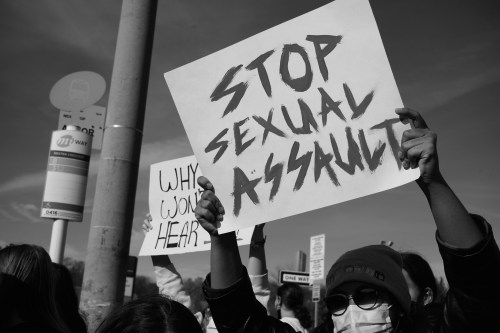
Open/Rolling Submission Call:
If you’d like to submit an essay/manifesto/poem etc to raise awareness about sexual violence and to break the silence, please email it to selfeducatingpoetsnetwork.org for consideration. Anonymous publication is possible.
In my first year of AmeriCorps, I walked into the director’s office at the community action agency and asked him to please ban the man who kept trying to run me over with his truck. This guy had figured out where I lived and waited for me to cross the street during which he would gun his car suddenly forward, taunting me with his power to take my life.
The director responded, “Oh I heard about you; you need to stop causing these problems. Get a spine and assert yourself better.”
When he said “I heard about you” he was referring to how I had filed a civil case against my former employer for repeatedly sexually harassing me to the point of assault. That boss, an older man in his 70s, had stood behind me as I made copies for him at the copy machine while he felt up my breasts. He forced kisses and he frequently fondled me inappropriately.
I confided in a friend who was also working there at the time, and she encouraged speaking up for justice. As we strode together along the creek, she urged “Think about all of the silenced folks, the ones who couldn’t come forward. You have the power to tell your story.”
One case manager gave me frozen peas and other food from her kitchen when she found out how little AmeriCorps paid (less than a thousand dollars per month). She was working class and didn’t have a lot of education to easily get a different job so she clung to her role at the office. She asked that I not come forward with my story because she didn’t want to lose her job, and she was realistic about these kinds of outcomes.
The other case manager treated me to dinner and shared her own stories of being sexually abused growing up and how she had avoided this boss she had a funny feeling about while keeping a record of all the women he had assaulted. She handed over a paper with at least twelve women’s names. My jaw dropped as I realized he had been doing this to women at the office for decades despite numerous testimonies.
Sometimes when he touched me inappropriately, I tried to “like it” because I thought that pleasure was better than pain, and I was used to masking all my life, pretending I was okay when I was not at all okay. I didn’t yet know I was autistic and struggled to advocate for myself even in a just environment much less one with rampant sexism.
My sister in law recently wrote an important post pointing to the roots of sexual violence. She says, “At its core, sexual violence is about power – who has it, who doesn’t, and what someone chooses to do with it.” The combination of being in the female category (though I now realize I am nonbinary) and being autistic made it incredibly difficult for me to read social cues and avoid dangerous situations. According to a recent article published in Frontiers in Behavior Neuroscience, 90 percent of autistic women have experienced sexual violence, significantly higher rates than the general population.
Not only did I have no idea why I seemed to be a constant target for sexist violence, I also wasn’t aware of my family’s brutal past. Yes, there were times I was in the bathroom with a razor to my skin in a haze of nonstop dissociation. Yes, there were times my uncle got drunk and told me something not repeatable here, but never did I anticipate the bombshell moment– finding out the documentary The Keepers came out on Netflix. This docuseries details the horrors of my mom’s school and painted the picture of constant sexual abuse that students survived at the hands of a terrible priest who had all the authorities behind him. Brazenly, he brought a student to the dead body of a nun (Sister Cathy) who he had likely murdered. The motive: So she wouldn’t come forward to talk about the sexual abuse her students reported.
I often think about Sister Cathy these days. I ask myself “What would Cathy do?” She would come forward and speak her truth. We were not meant to drown without making a sound. When I found my aunt’s journal, I read her secret poetry about screaming in the blood of women. My heart aches for my family, which has never found justice and has endured generations of shattering. My nonbinary soul aches that these discussions about sexual violence so often erase gender fluidity. In fact, I think my nonbinary realization was much delayed (not until my 30s) because I didn’t know how to understand myself outside of histories of binary sexual violence.
When I moved to the city and frequented poetry open mics, I started to meet other artists. Collectively, we built our own worlds that do not yet exist in all contexts. The lens of trauma never goes away but it churns with truth telling and centering marginalized voices. I started DIY MFA: Self-Educating Poets Network in the early part of the pandemic with the help of poets I met through the poetry slam community. This blog is the first in a series, working through a life-long healing journey. I am encouraging others to submit their stories and never stop fighting for justice, though I admit we need more than simple awareness. I hope for creative communities like these to be forums for greater cultural and political change.

